Can you claim your business in ChatGPT?

claim business in chatgpt

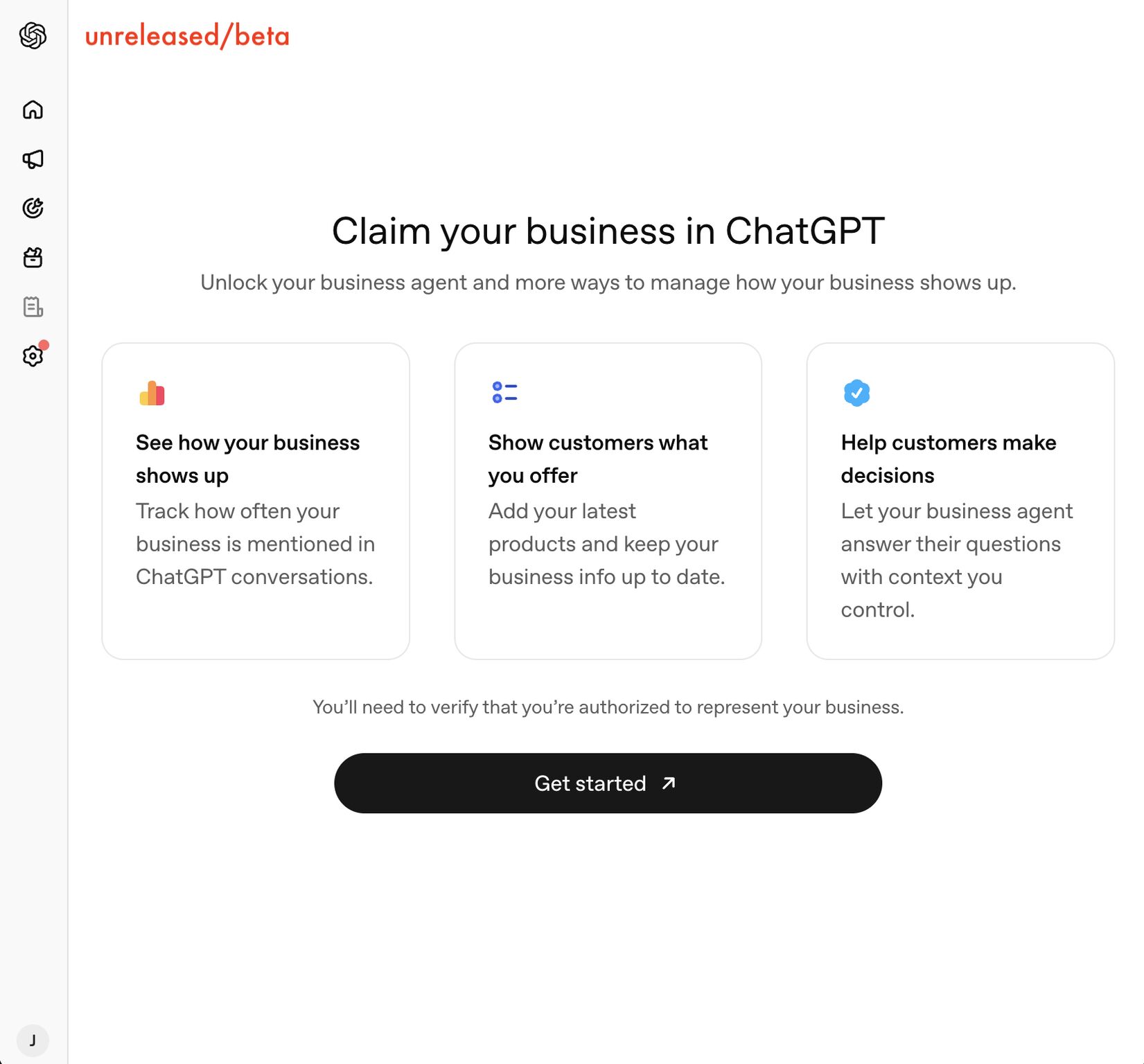
A screenshot doing the rounds in the marketing community in early November 2026 appears to show that ChatGPT is developing a tool that lets businesses track their brand’s success on the platform and manage some aspects of how the business is shown to the people using it. Posted about on LinkedIn by Juozas Kaziukėnas, it looks like eligible brands will soon be able to ‘claim’ their business in ChatGPT, which may enable them to:

  • Track how often the business is mentioned in ChatGPT conversations or responses (impressions and clicks)
  • Showcase what the business offers and keep products/info up to date
  • Answer customer questions with context that the business controls

With the information available at the moment (no official public announcements about it by OpenAI yet) it looks like this tool might be some kind of blend of the equivalent Google Business Profile and Google Search Console types of data and functionality. 

Screengrab showing ChatGPT Business dashboard

Image source – Juozas Kaziukėnas LinkedIn post

It’s unclear at this stage how businesses can verify to ChatGPT that they’re authorised to act on behalf of the company, but it seems likely that this could all tie into a wider ChatGPT Business Hub that opens certain features to businesses that have connected their website to ChatGPT. 

It looks like the data provided in this dashboard by ChatGPT won’t show the prompts that people used to spark a brand mention, or have any kind of competitor benchmark or ranking information. But until now, businesses wanting to track AI visibility have been entirely dependent on third party tools, so potential access to first party data could be a great step forward if it helps provide accurate performance metrics and actionable insights for improvement. 

Once this feature has launched with a testable process, we’ll develop a guide for businesses. In the meantime, you can still work on the information, evidence and technical foundations that support your discovery across AI platforms and elsewhere online. 

Jump to:

How to show up in ChatGPT results as a business

Your next customer could be asking ChatGPT who to choose, between brands that do exactly what you do. Does your business enter the conversation?

When someone asks for a shortlist of suppliers, compares products or researches a specialist service, being mentioned can put your business in the frame. The opportunity is to appear in the conversations that matter, with accurate information and a clear reason to consider you.

Your business can be mentioned in ChatGPT right now without a dedicated claimed profile. To improve your foundations for discovery, you’ll need to:

  • Make your website accessible
  • Explain your products and services
  • Show your purpose clearly
  • Answer the questions customers ask before buying (like delivery, returns, warranty, ratings etc)
  • Build credible evidence of your expertise across relevant sources.

There are three different outcomes from ChatGPT currently:

A brand mention

ChatGPT names your business. That could be a passing reference or part of a comparison. 

A citation

ChatGPT links to a page on your website as an information source. It may cite your content without recommending your business for anything specific. 

A recommendation

ChatGPT presents your business as a potential option for meeting the needs of the user.

Any and all of these can have value to your business, and can form part of a wider GEO strategy to help your brand be found and chosen wherever your customers are searching and making decisions. 

“It’s great to see ChatGPT (potentially) leading the way in delivering the first iteration of reporting for a LLM. I think it won’t be long before Claude, Gemini and Perplexity follow suit - it’s the natural next step for monetisation and building relationships with the real content owners. I’m excited to see how this will shape things, to have a play with genuine first-party LLM data, and watch how third party tools that are currently crazy-prices will react! Fingers crossed now.”
Laura
Head of Strategy & Search

How to increase ChatGPT visibility 

Our approach starts with your customers: what they need, how they research and what helps them choose. The following steps can give you a great starting point. 

1. Find the conversations worth appearing in

A good place to start is with the questions people ask before they know a brand’s name.

Build your research around real buying decisions. What do your audience need to know about suitability, cost, comparisons, implementation and support.

2. Check whether your website is accessible

Useful content needs to be reachable by LLMs in order to have AI visibility. 

OpenAI has “OAI-SearchBot” as its official search crawler and recommends allowing it through your website’s robots.txt rules and relevant network controls to support inclusion in ChatGPT search results. 

OAI-SearchBot and GPTBot have separate purposes. GPTBot concerns content that may be used for model training; allowing training is not a requirement for allowing search crawling.

Ask your technical team to check crawler access, security restrictions and whether important public pages can be retrieved successfully. Allowing access supports eligibility but it does not guarantee any citations or recommendations.

3. Make what you do or sell really easy to understand

Could someone who doesn’t know your brand work out who you help, what you provide and why you might suit their needs?

Review your main service and product pages. They should explain:

  • What you offer
  • Who it’s suitable for 
  • Where you operate or deliver to
  • Why you can be trusted (with real evidence)
  • How your audience can take the next step.

Following Google’s E-E-A-T framework for your website content will help ensure that you are implementing all of the above and more, providing users with everything they need to make informed decisions. 

4. Answer the questions that shape decisions

You need to meet your audience’s informational needs at all stages of the buying journey so look beyond broad introductory content. Your potential customers may need to understand costs, alternatives, timescales, compatibility or what happens after they enquire/buy.

Build those answers into the pages where they are most useful. That could mean a detailed service explanation, a buying guide, clear product specifications or a practical case study.

Bring your own expertise into the content. Show examples of your specialist knowledge and support these claims with evidence that readers can check. 

This gives prospective customers stronger information to work with, builds trust and creates useful material for search discovery.

5. Build credible evidence beyond your website

Your own website and your social media presence tells part of the story. Customers may also assess your business through reviews, industry publications, professional directories and independent coverage.

Focus on the sources that matter in your market to your audience. Keep relevant profiles accurate, encourage honest customer feedback and look for opportunities to contribute useful expertise on relevant topics in the media.

Digital PR campaigns can help put original research or unique data, informed commentary and strong stories in front of relevant audiences. A meaningful mention in the right publication can support your reputation whether someone discovers it through search, social, an AI answer or the publication itself.

6. Keep important information current and consistent

Outdated information makes buying harder. Check your website and the external profiles you manage for old service or product descriptions, conflicting contact details and unsupported claims.

For businesses with several locations, make each location’s offer and contact information clear. For product businesses, prioritise accurate specifications, availability and purchasing information.

Use structured data where appropriate to describe information that is genuinely present on the page (like Organization or Product Schema). Treat it as part of maintaining a well-organised website, with any increase in AI visibility a great bonus.
What could ChatGPT business analytics add?

If the potential reporting becomes available, it could offer information businesses cannot obtain from manual prompt checks and third party tools alone.

Its value will depend on what is counted, which conversations are covered and what context accompanies the figures. A mention prompted by a customer typing your name is different from an unsolicited recommendation during supplier research.

Before using any future dashboard to guide investment, businesses will need to understand:

  • How a mention is defined.
  • Whether recommendations and citations are reported separately.
  • Which markets, time periods and conversations the data covers.
  • Whether it helps explain the topics associated with the brand.
  • Whether any reporting connects to website visits or other measurable actions.

Context is really important here because the data is only useful if it provides insights you can actually use and leverage to achieve your commercial goals. 

Where ChatGPT fits in your marketing strategy

A customer might encounter your brand through a publication, check reviews, ask ChatGPT for a comparison and then search Google before making contact.

Plan for that connected journey. Your technical SEO, expert content, digital PR and social marketing activity should help people find consistent information and understand why your business is worth considering.

At No Brainer, we bring those disciplines together through Search+Discovery®. We look at the questions your audience asks, the information they find and the opportunities to turn that attention into business growth – powered by Seer®.

ChatGPT visibility, along with the other AI platforms, is one part of that work.

Is your brand part of the conversation?

Find out where your business appears and which opportunities you should prioritise. Our team connects SEO, content and digital PR to help the right people discover your brand and understand why to choose you.

Talk to us about your AI search visibility. Use the form below to get in touch. 

Picture of Laura Rudd
Laura Rudd
I’ve worked in digital marketing for over 20 years, specialising in integrated marketing strategy for over half of that time. My career has spanned both agency-side and in-house roles, working alongside brands like HomeServe, Taking Care, Checkatrade, and AO.com. My expertise centres on commercial growth, where I’m passionate about how integrated marketing strategy drives revenue performance.
Share this article

Looking for commercial growth?

Want to chat?

Leave your details and one of our experts will contact you!