The essential guide to AEO (Answer Engine Optimisation)

guide to AEO

How people search for information online is going through a fundamental shift; the biggest change since search engines began. People aren’t just looking for related information that they can browse through, they want the actual answers – now. 

Whether it’s Google’s AI Overviews, ChatGPT, Gemini, Perplexity or voice assistants, we’re well on the way to being in an answer-first ecosystem. Traditional SEO still matters and has a big role to play for most users, but it’s no longer enough to focus on it without also considering AI’s role in search.

Enter AEO.

Answer Engine Optimisation, also known as GEO, isn’t a wishy-washy future concept; it’s a present-day consideration and potentially a competitive advantage. This guide breaks down what it is, why it matters and how marketers can leverage it in a practical and scalable way that actually makes a tangible difference to your brand or business.

Jump to: 

What is AEO?

AEO is the process of optimising your website content, technical setup and authority signals so that AI systems and search engines can find, evaluate and surface your content as a direct answer to relevant user queries.

This goes well beyond ranking #1 for exact match keyword phrases. In an AEO-driven world, your goal is to:

  • Be cited and linked to from AI-generated answers
  • Power “zero-click” responses
  • Become a trusted source in knowledge graphs and entity systems

Visibility shift

In traditional SEO:

  • The user searches → sees list of links → clicks through on the most engaging or relevant-looking result in the list

With AEO:

  • The user asks a question → receives a synthesised answer that directly addresses their query → may never need to click through to a website

Your brand’s visibility now partially depends on whether you are:

  • Mentioned in the answer
  • Referenced as a source for the answer
  • Structurally understandable to AI

The reality is that many of the principles for effective SEO and AEO overlap, but there are some differences that we’ll cover in this guide. 
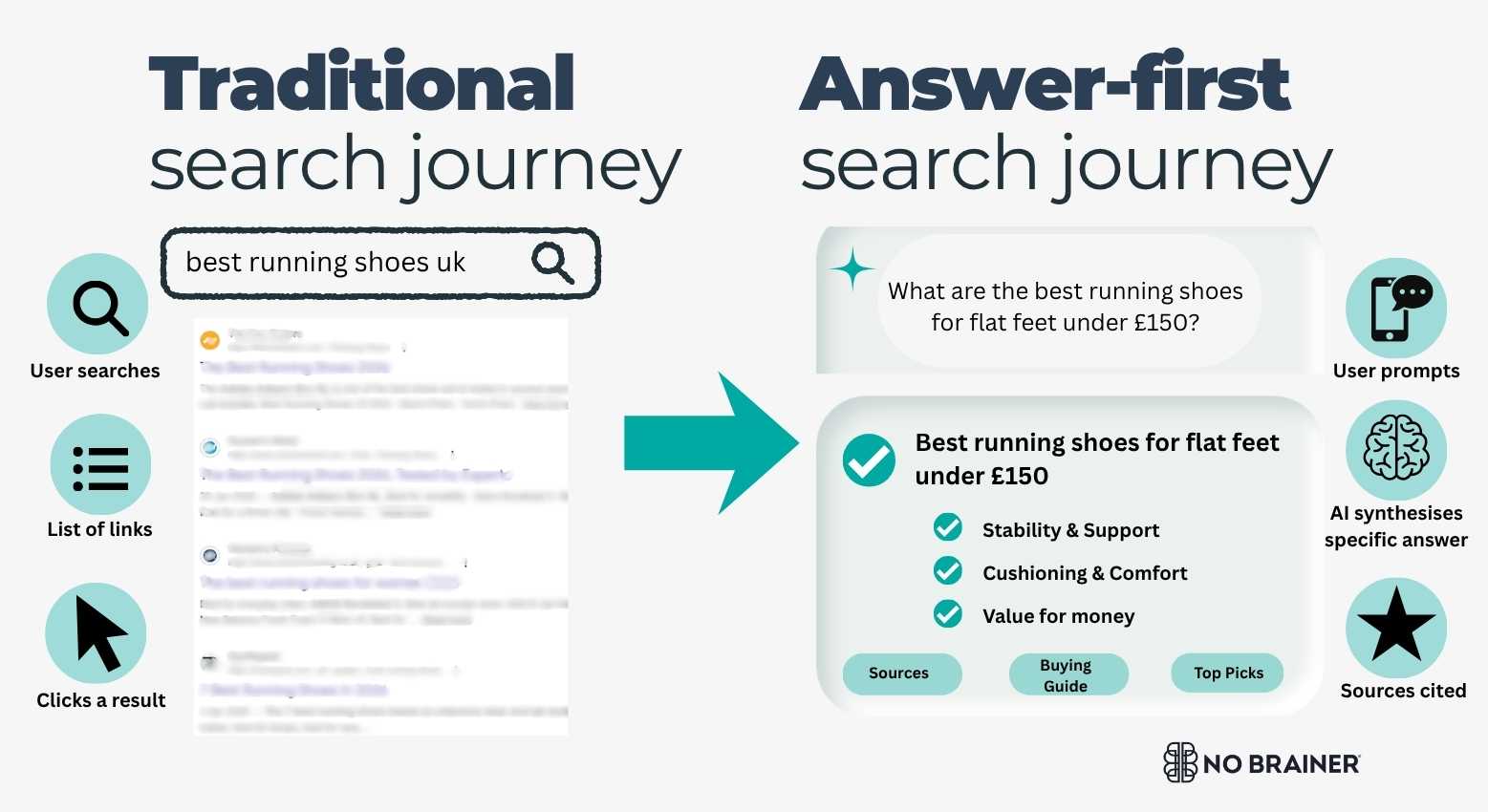
traditional vs answer first search journey

Is AEO different to GEO and AIO?

If there’s something the marketing world doesn’t need, it’s more acronyms. But we are where we are, and the evolution of AI has brought several new ones to the party. 

We’ve defined some of the main terms currently being used most commonly below:

  • GEO (Generative Engine Optimisation) 

GEO focuses on trying to get content summarised, cited and referenced in AI-generated responses by tools such as ChatGPT, Gemini, Perplexity, Copilot and others.

  • AIO (AI Optimisation)

Not to be confused with AI Overviews (also sometimes confusingly called AIO), which are the AI-generated summaries seen at the top of most Google search results.

AIO is a broad term used by some marketers that covers optimising websites and content for any AI-driven discovery system. 

  • LLMO (Large Language Model Optimisation)

LLMO focuses on optimising content for large language models (LLMs) generally and how they understand, retrieve and reuse content. 

AEO essentially overlaps with all of these, because creating clear, authoritative and well-structured answers not only helps content get selected as direct responses within these platforms, but also increases its chances of it being understood, reused, and cited by AI systems in other contexts too. 

Essentially, optimising to be the answer through a clear AEO strategy utilises the same signals (context, credibility and machine readability) that power visibility across generative engines (GEO), broader AI ecosystems (AIO), and large language models (LLMs).

Why AEO matters for marketers

1. The rise of zero-click behaviour

Users are increasingly getting answers directly in:

  • AI Overviews (Google)
  • Featured snippets
  • Voice responses
  • Chat-based tools

This has reduced traditional traffic clicking through to websites from search results but increases the importance of being the source behind the answer.

2. The conversational layer of search

You’re not optimising for keywords anymore;  it’s natural language that cuts directly to what the user wants.

For example, an old query could be something like:

“best running shoes UK”

Now, it’s more likely be something close to:

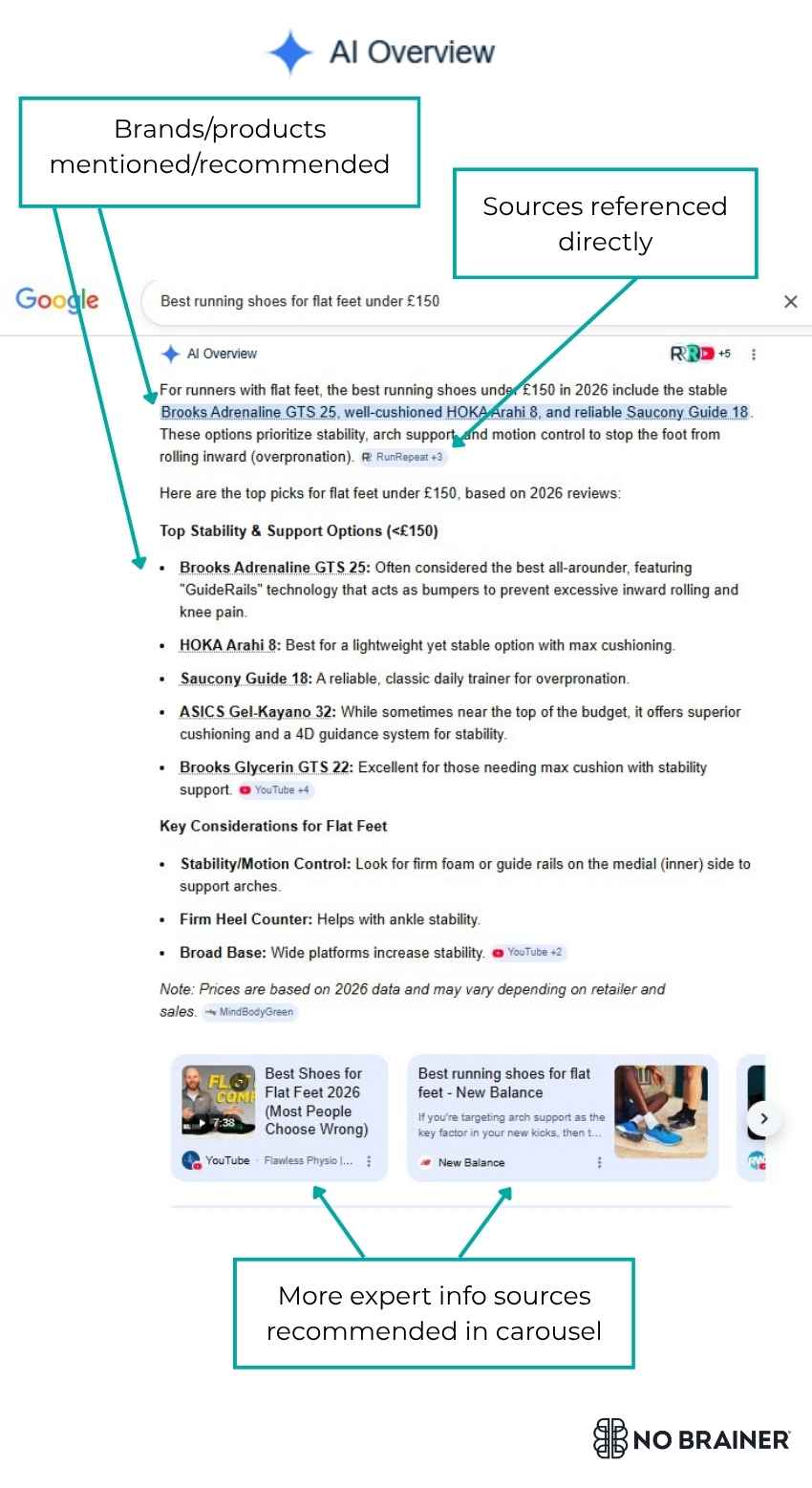
“what are the best running shoes for flat feet under £150?”

This means that content needs to:

  • Match intent precisely
  • Answer questions clearly
  • Anticipate follow-up questions

Running shoes AI overview example

3. Pre-search discovery

Users are now discovering brands before they ever search directly, through:

  • AI recommendations
  • Summarised comparisons
  • Aggregated knowledge sources

If your brand isn’t structured for AEO, you risk becoming invisible in these kinds of journeys.

4. Voice and multimodal search

Voice assistants and AI agents prioritise:

  • Concise, authoritative answers
  • Structured information
  • Trusted sources

AEO is essential for capturing these interactions and making sure that your brand is part of the conversation.

The risks of not having an AEO strategy

As search behavior continues to shift, businesses that fail to adopt an AEO strategy face growing strategic risks. These can directly impact visibility, brand perception, and revenue potential.

Loss of search visibility

As we know, search engines are increasingly prioritising directs answers, featured snippets, and AI-generated responses over traditional link listings. If your content is not optimised for AEO:

  • Your website may never appear in the most prominent positions
  • Competitors can ‘own’ the answer space, even for core topics you’re an expert in

In an AEO-driven landscape, ranking #1 is no longer the goal; being the chosen answer is.

Erosion of brand authority

When AI tools like ChatGPT or voice assistants provide answers, they often use content from sources they deem most authoritative and structured.

Without AEO:

  • Your brand is more likely to be absent from key conversations
  • Competitors can become the default trusted source instead of you
  • You lose control over how your expertise is represented

Over time, this can weaken brand credibility and reduce your perceived leadership in your industry.

Reduced discoverability in voice and AI search

Voice assistants like Amazon Alexa and Google Assistant will typically deliver one single answer to a user query. 

If your content isn’t optimised for answer engines then you run the risk of:

  • Becoming effectively invisible in voice search results, as there is no ‘second place’ opportunity in this space
  • Missing out in a rapidly growing segment of search behaviour

Declining click-through rates from organic search

Even if your website ranks well traditionally, AI-generated summaries and featured snippets are taking more real estate at the top of results pages and reduce the need for users to click anywhere else in order to find the answers they want. 

There are still opportunities to feature as a trusted source, but without AEO:

  • Your content is less likely to be featured in these summaries or your website cited as a source
  • Click-through rates drop as competitors capture attention instead of you

A competitive disadvantage

Businesses actively investing in AEO are structuring their content to answer high intent questions clearly, aligning with how AI systems retrieve information and are able to capture visibility across multiple platforms at once. 

Without an AEO strategy that is implemented effectively:

  • You can quickly fall behind competitors who dominate answer-based search
  • Your customer acquisition costs may increase as organic reach shrinks
  • You become more reliant on paid channels to maintain visibility

Taking action now can help to ensure that your business continues to have a voice at the table, build more topical authority and take advantage of the opportunities that answer engines bring. 

Technical foundations for AEO

AEO is not just about content though. Just like with traditional SEO, the technical structure of your website is critical if you want to maximise your visibility and sustain performance over time.

1. Site structure

Your site should clearly communicate:

  • Topic hierarchies
  • Relationships between pages
  • Logical navigation paths

Actionable steps you can take to improve site structure:

  • Implement clear topic clusters (pillar + supporting content)
  • Avoid orphaned pages
  • Ensure URLs reflect the hierarchy

2. Schema markup & structured data

Structured data helps various systems better understand your content.

Key schema types:

  • FAQ schema
  • HowTo schema
  • Article schema
  • Product schema (critical for ecommerce)

Actionable steps you can take to improve schema implementation:

  • Mark up FAQs on key pages (after adding FAQs if they don’t already exist)
  • Add structured product data (price, reviews, availability)
  • Ensure schema consistency across templates
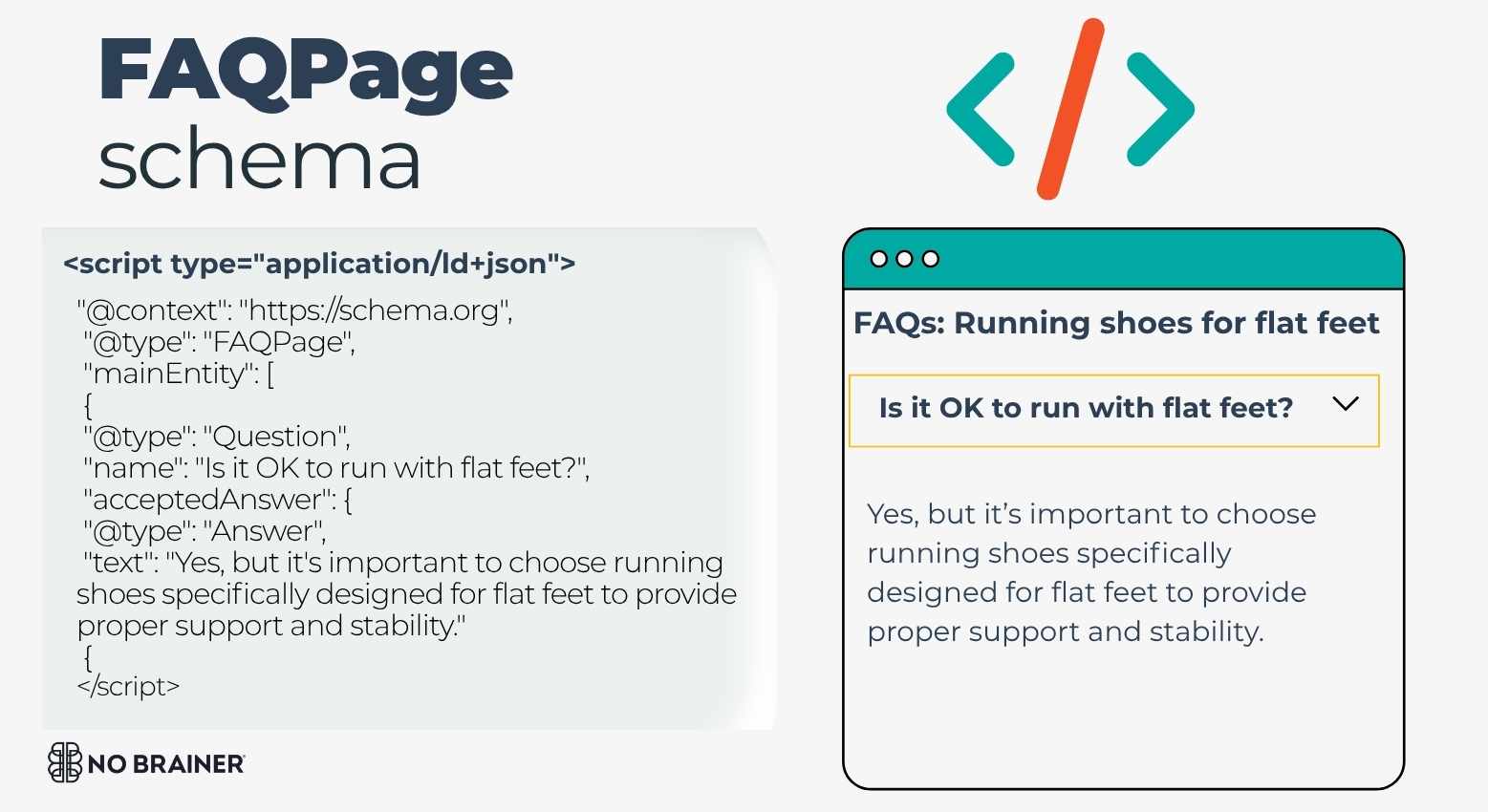
FAQ schema example

3. Entity relationships & knowledge graphs

Search engines and the AI-powered features they offer increasingly rely on entities (people, brands, concepts).

Your goal is to:

  • Be recognised as a distinct entity
  • Be connected/associated to relevant topics

Actionable steps you can take:

  • Maintain consistent brand naming
  • Build strong internal linking between related topics on your website
  • Earn mentions from relevant and authoritative sources (through digital PR)

4. Crawlability fundamentals

If search engines can’t access your content, AEO can’t fulfil its potential in relation to your website.

Quick checklist:

  • XML sitemap is up to date
  • Robots.txt is not blocking key content
  • Internal linking supports discovery of related content
  • Page speed is optimised

5. AI readiness in content structure

AI systems prefer content that is:

  • Chunked into sections
  • Clearly structured
  • Easy to extract

Actionable steps you can take:

  • Use short paragraphs
  • Add clear subheadings
  • Include summaries and bullet points where appropriate
 

Content optimisation for AEO

With any website content, it’s important to take a user-first approach and base your content on what your audience want and need to know, but that doesn’t mean that you can’t also take into account what generative AI is looking for. 

The areas to consider include:

1. Authority signals (E-E-A-T)

Experience, Expertise, Authoritativeness, Trust.

This is about building credibility in relation to your brand, the topics you are an expert in and the usefulness of your content. 

Actionable steps to build authority:

  • Consider authorship: Add author bios with credentials
  • Include real data, examples and insights
  • Reference credible sources only
  • Showcase brand expertise (case studies, unique research etc.)

2. Answer-first formatting

Your content should lead with the answer, not bury it under text or loosely related visuals.

An example of what is “bad”:

Long intro → context → eventual answer

An example of “good”:

Direct answer → supporting detail → deeper exploration

Actionable structure for better answers:

  • Start sections with a clear answer
  • Follow with explanation
  • Add examples or nuance at the end of the section

3. Question targeting

Build content around real questions that your audience ask.

Sources you can use to discover these questions include:

  • Search data, including Google’s People Also Ask (PAA) and your website’s internal site search function (if available)
  • Customer service queries
  • Sales conversations

Actionable steps to target questions better include:

  • Turn FAQs into full sections, using H2/H3 etc as appropriate and FAQ schema
  • Answer concisely (40–60 words is ideal for an initial answer) before adding more context or detail as needed.

4. Natural, conversational language

AI prefers content that mirrors human conversation.

Things to avoid when answering questions:

  • An overly formal tone 
  • Using unexplained jargon or flowery language unnecessarily
  • Keyword stuffing the answers

Instead, you can:

  • Write as if explaining to a colleague
  • Use clear, simple language
  • Be precise in the information you provide. Avoid vague or ambiguous answers.

5. Topic depth and coverage

Thin content us very unlikely be selected as an answer source by generative AI.

You need:

  • Comprehensive coverage of the main topic
  • Supporting subtopics
  • Contextual relevance

Actionable steps to improve topic depth:

  • Map topic clusters
  • Build supporting articles
  • Cover long-tail queries

AI-ready content structuring techniques

Content chunking

Break content into digestible sections:

  • One idea per section
  • Clear headings/subheadings
  • Logical flow

Passage ranking optimisation

Search engines can extract specific sections of a page. This means that every section of content should be able to stand alone as a clear answer.

Clear hierarchies

Use:

  • H1 → H2 → H3 structure
  • Logical nesting
  • Consistent formatting

“Fraggles” (fragment optimisation)

Optimise small sections to be:

  • Independently understandable
  • Highly relevant to a specific question

Have a topic coverage strategy

It can be helpful to think of systems, rather than pages, when developing your topic coverage strategy. Consider not just top of the funnel user needs, but the entire journey through to a purchase decision.

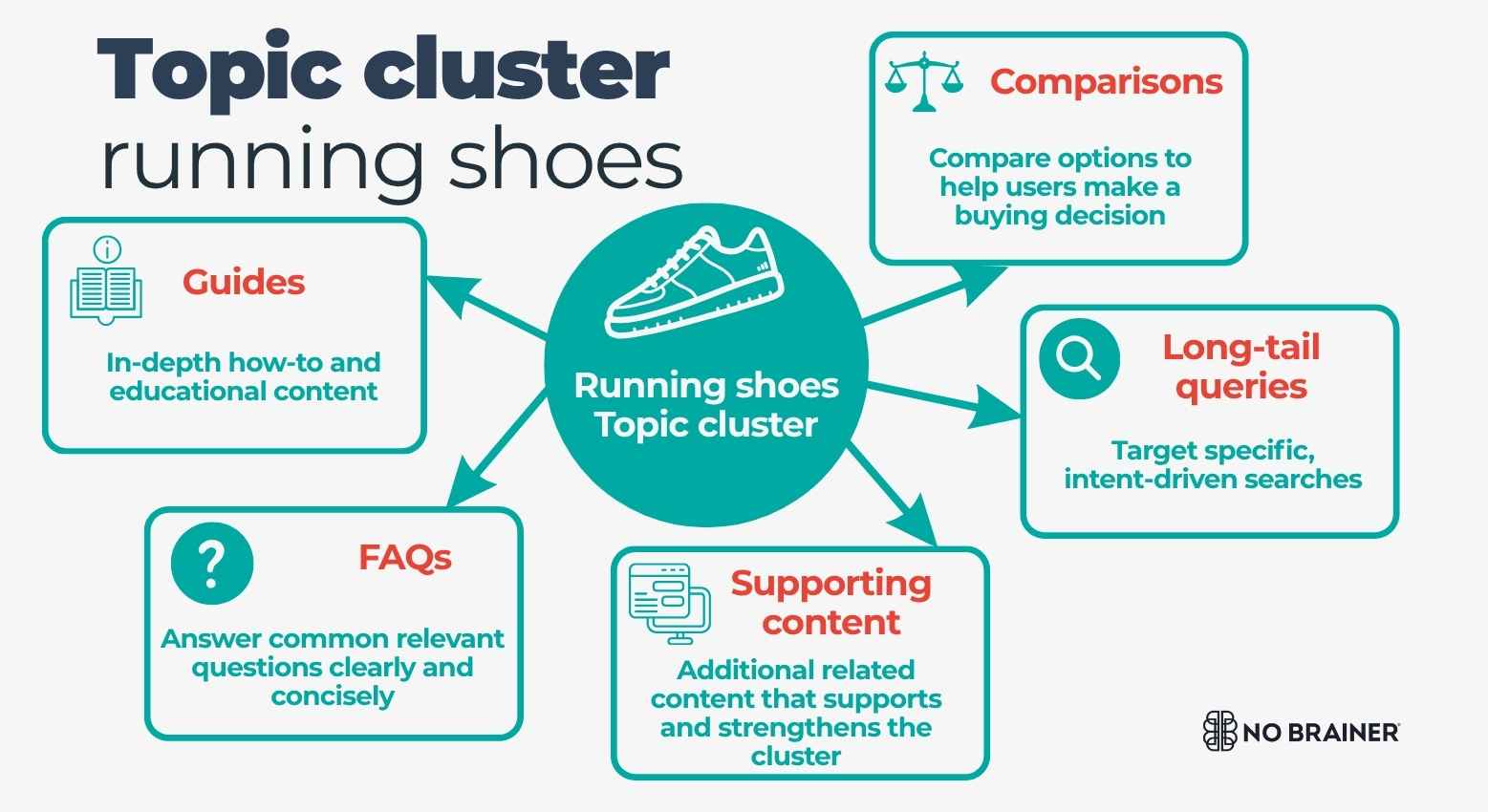
Build topic ecosystems

For example:

  • “Running shoes” →
    • Best running shoes for beginners
    • How to choose running shoes
    • Running shoe sizing guide
    • Brand comparisons

Don’t forget to cover long-tail queries

These are:

  • More specific
  • Very intentional – there is a clear user goal here
  • Aligned both with traditional SEO and now AEO

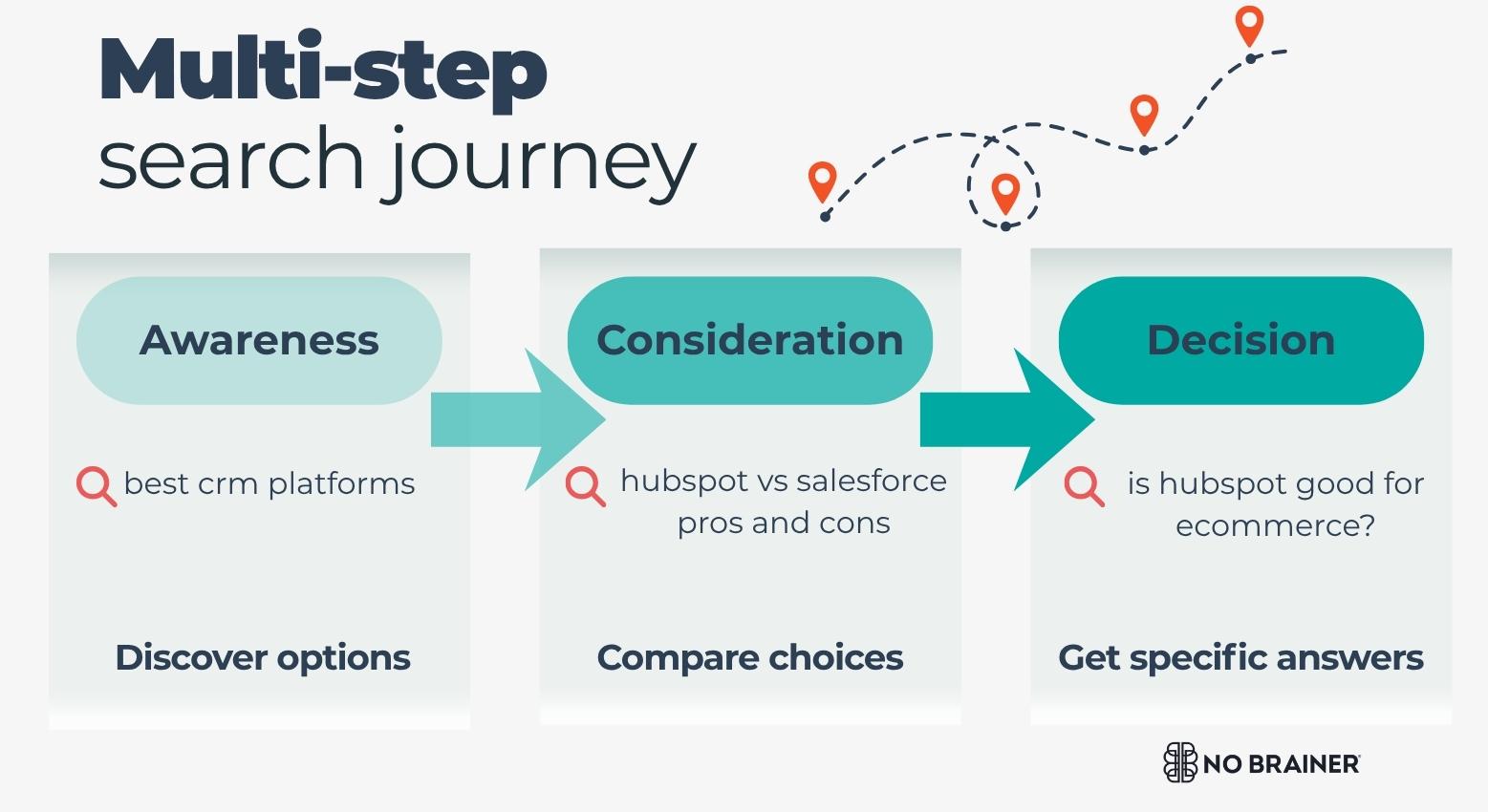
Align with user intent stages

  • Awareness → e.g. “what is…”
  • Consideration → e.g. “best options for…”
  • Decision → e.g. “X vs Y”

Topic cluster example

Content formats that work for AEO

Not all content formats are equal in an answer-driven world.

High-performing formats include:

  1. How-to guides

Step-by-step, structured and contain highly “extractable” sections.

  1. Comparison posts

Perfect for AI Overviews, summaries and decision-making queries.

  1. “What is” explainers

Core for top-of-funnel and AI definitions.

  1. FAQs

Direct alignment with question-based search.

  1. Case studies

Strong authority signals and real-world validation of your brand, products or services.

  1. Best practice guides

Demonstrate expertise and depth of knowledge.

  1. Problem/solution content

Aligns directly with user intent.

  1. Checklists

Highly scannable and AI-friendly.
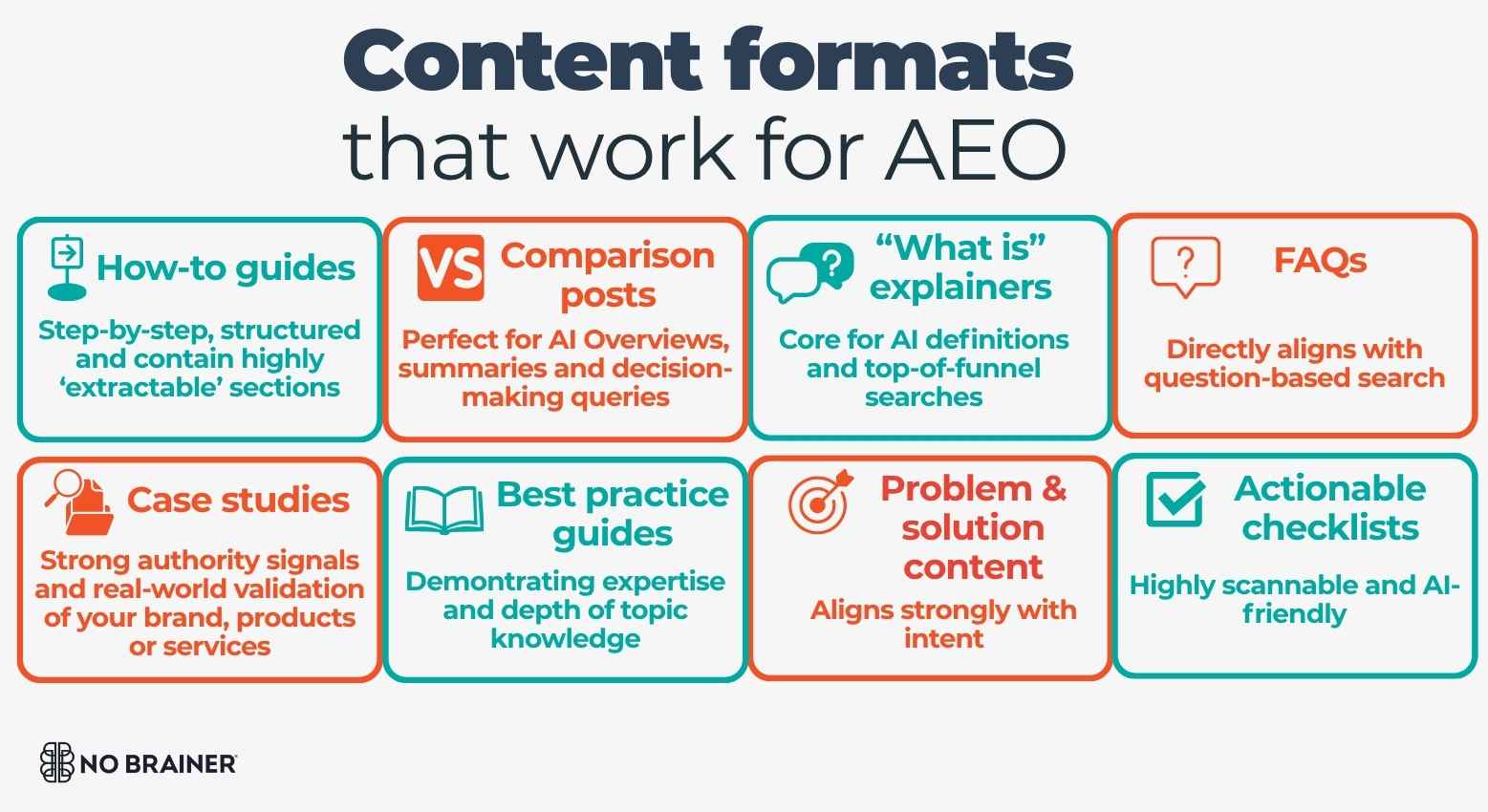
AEO content formats

AEO implementation roadmap

For many brands and businesses, especially those with large and established websites, the challenge is successful execution at scale.

Phase 1: Content Audit

  • Identify key content gaps
  • Assess technical readiness
  • Review authority signals

View our content audit essentials guide with free template. 

Phase 2: Prioritisation for action

Focus on:

  • High-value commercial topics
  • High-intent queries
  • Existing content with optimisation potential

Phase 3: Content transformation

  • Rewrite key pages in answer-first format
  • Add structured data
  • Improve internal linking

Phase 4: Expansion

  • Build topic clusters
  • Develop supporting content
  • Scale question targeting

Phase 5: Authority building

  • Digital PR for meaningful mentions and citations
  • Authorship and thought leadership content
  • Expert contributions from well-known independent specialists

AEO isn’t replacing SEO – it’s evolving it

A mindset shift is needed in order to successfully leverage SEO alongside AEO and get the best of both worlds.

It’s a bit less about…

  • Rankings
  • Keywords
  • Traffic

And a bit more about…

  • Answers
  • Entities
  • Visibility across ecosystems

The brands that can effectively use AEO as a competitive advantage will be those that:

  • Structure content for people and machines
  • Build authority beyond your own site
  • Think in terms of topics, not individual pages

AEO is not just a tactic. It’s a strategic evolution of how people find the information they want and how visibility works online.

If you’d like to ensure that your online presence is AEO-ready, get in touch with us using the form below to find out more about how we can help. 

Picture of Laura Rudd
Laura Rudd
I’ve worked in digital marketing for over 20 years, specialising in integrated marketing strategy for over half of that time. My career has spanned both agency-side and in-house roles, working alongside brands like HomeServe, Taking Care, Checkatrade, and AO.com. My expertise centres on commercial growth, where I’m passionate about how integrated marketing strategy drives revenue performance.
Share this article

Looking for commercial growth?

Want to chat?

Leave your details and one of our experts will contact you!