
What is zero-click search?
Zero-click search refers to searches where users find the information they need without having to click through to another website.
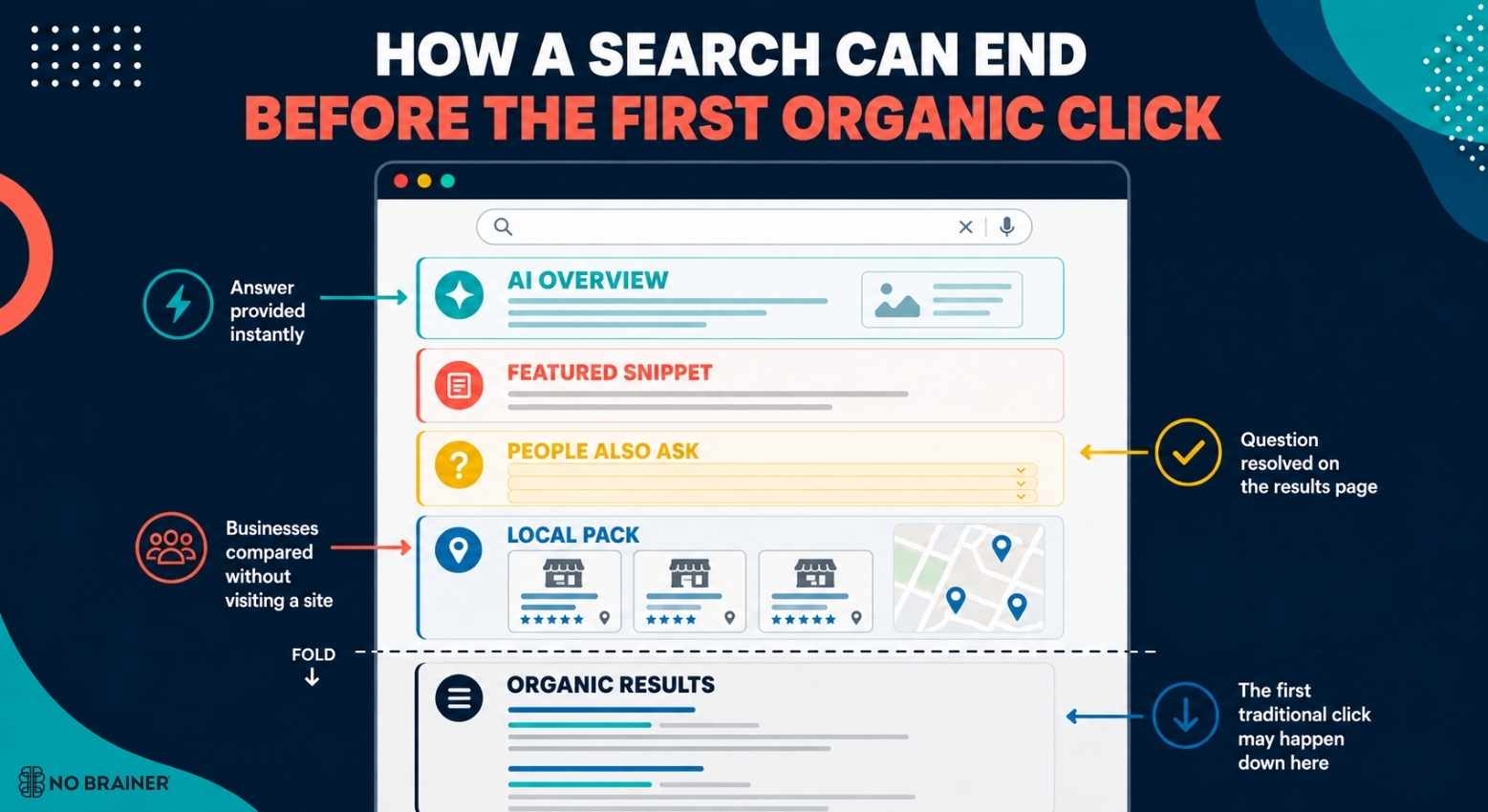
Google increasingly provides answers directly within search results through features such as AI Overviews, Featured Snippets, Knowledge Panels, Local Packs and People Also Ask results. Meanwhile, AI assistants can summarise information from multiple sources in seconds, often reducing the need for users to visit every website individually.
It’s important to note that people aren’t necessarily searching less, they’re just clicking less.
For marketers, this represents one of the biggest changes to organic search in years, which says a lot for an industry that is constantly evolving. Visibility still matters, but simply appearing in search results is no longer enough to guarantee organic traffic. We need to incorporate AEO into the fabric of the marketing mix.
Why organic traffic is becoming harder to earn
Zero-click search is only one part of a much bigger transformation in how people discover brands.
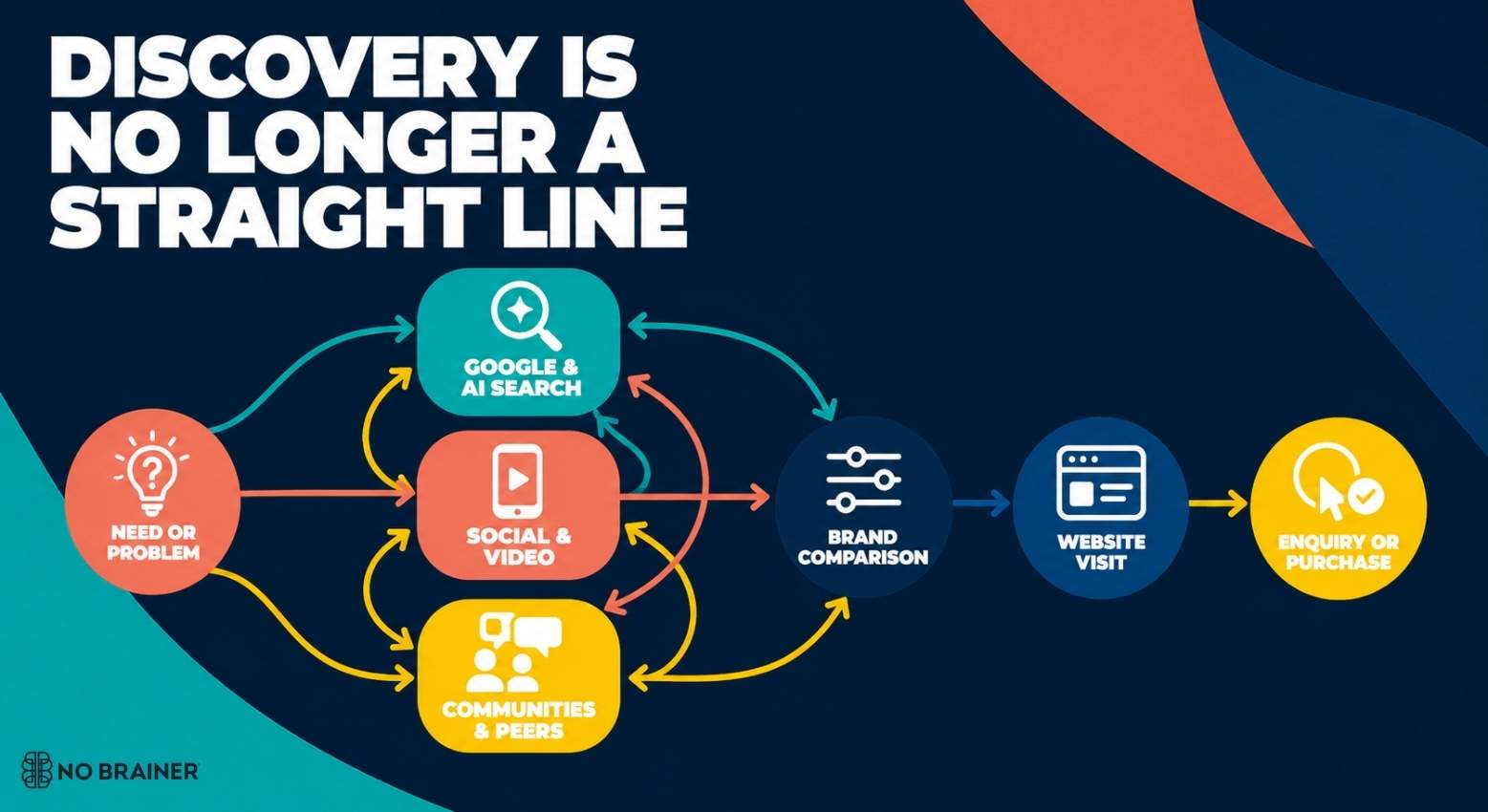
Today’s buying journeys rarely begin and end with Google. Someone might first hear about your business on LinkedIn, ask ChatGPT for recommendations, watch a YouTube comparison, browse Reddit discussions and only visit your website when they’re close to making a decision.
At the same time, Google continues to answer more informational questions directly within search results, meaning many users never need to leave the search page.
This has several implications for businesses:
- Informational searches are less likely to generate website visits.
- Competition for commercial searches is intensifying.
- Users who do click are often further through the buying journey.
- Content needs to demonstrate genuine expertise rather than simply answering obvious questions.
Rather than chasing every possible keyword, successful brands are focusing on becoming the trusted source that users actively choose to engage with.
Content that still earns clicks
Despite predictions of the end of content marketing, people still actively seek out content that offers something genuinely valuable.
The question is no longer, “Can I answer this question?”
It’s, “Can I answer it better than anyone else?”
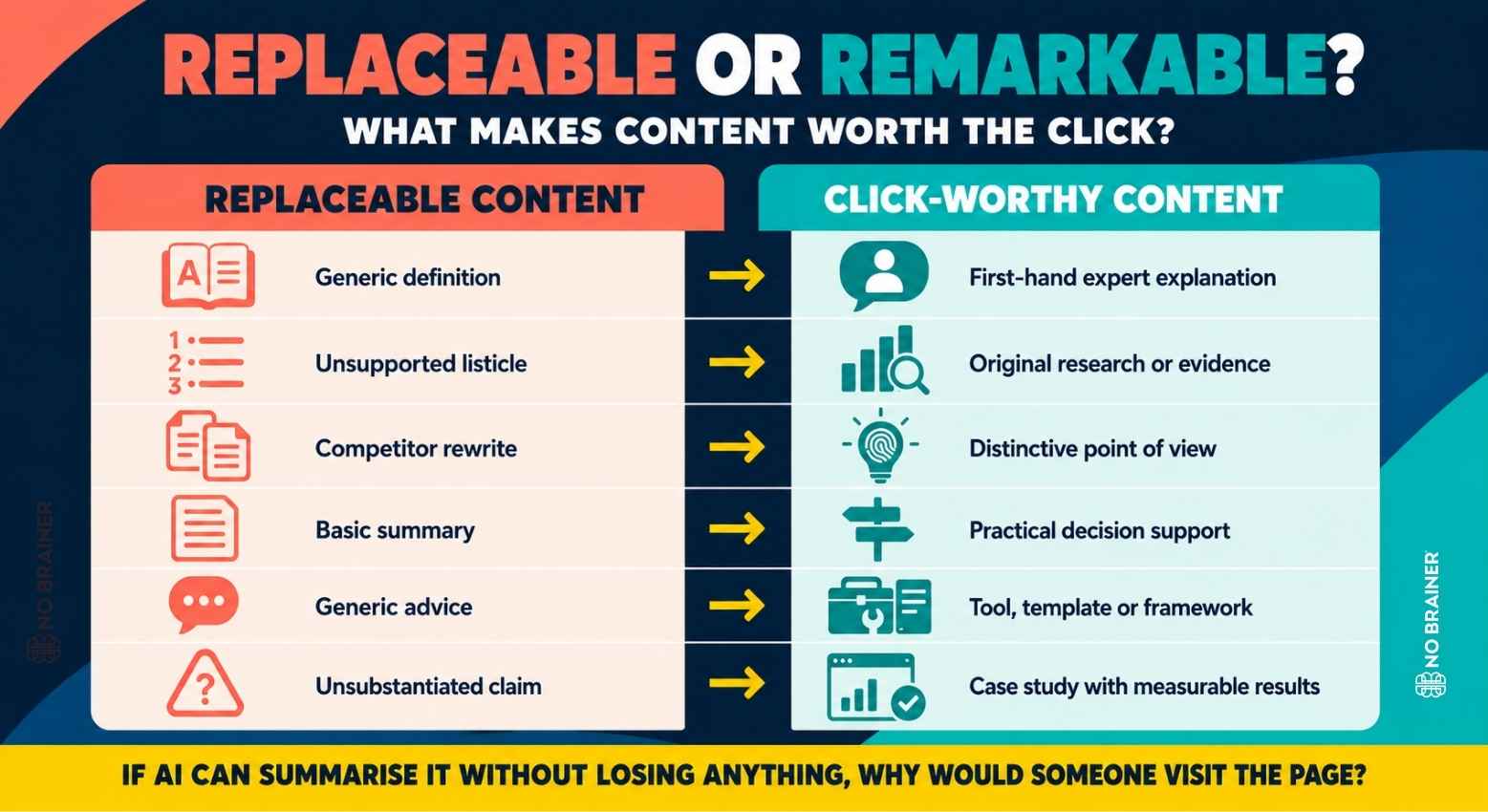
The elements that you can leverage to drive relevant click-throughs include:
Original research and data
Robust surveys, benchmarking reports, industry research and proprietary data give audiences information they simply can’t find elsewhere. They also attract backlinks, media coverage and citations.
Expert insight
Experience has become one of the most valuable differentiators for online content. It’s part of Google’s E-E-A-T framework and turns what could have been bog-standard information into something that is genuinely worth delving into.
Rather than summarising what others have written, explain what you’ve seen first-hand, what you’ve learned and what the evidence suggests.
AI summaries and content surfacing can’t compete with original thinking.
Commercial decision-making content
When people are comparing providers, products or services, they often want far more detail than an AI summary can provide.
Content such as comparison guides, pricing explanations, buyer’s guides, implementation advice and service comparisons remains highly valuable because it supports real purchasing decisions.
Case studies
Nothing builds confidence like evidence. Demonstrating measurable outcomes, explaining your approach and showcasing real client success stories (and what those clients say about you) helps prospective customers visualise similar results for their own business.
Interactive tools
Calculators, audits, assessments, templates and planning tools create genuine reasons for people to visit your website while delivering immediate value to users as part of their buying journey, even if it’s fairly top of the funnel at times. Yes, they do take time and effort to produce, but not only can they be a useful traffic driver, they can be great for earning natural links from relevant sites too.
They’re also considerably harder for competitors and AI to replicate.
Comprehensive strategic guides
Rather than simply answering one question, you can create resources that help readers understand an entire topic, make informed decisions and confidently take the next step on their journey.
The aim isn’t to produce longer content for the sake of it, it’s to produce genuinely more useful content that also sends clear signals to search engines and AI tools.
Video and visual content
Complex topics are often easier to understand through diagrams, videos, animations or interactive graphics than through text alone. Visuals are another content element that take real time and other resources to get right, but they can make a huge difference to the usefulness of a page.
Visual content also increases engagement and gives users another reason to spend time with your brand rather than relying solely on AI summaries.
How content strategy needs to evolve
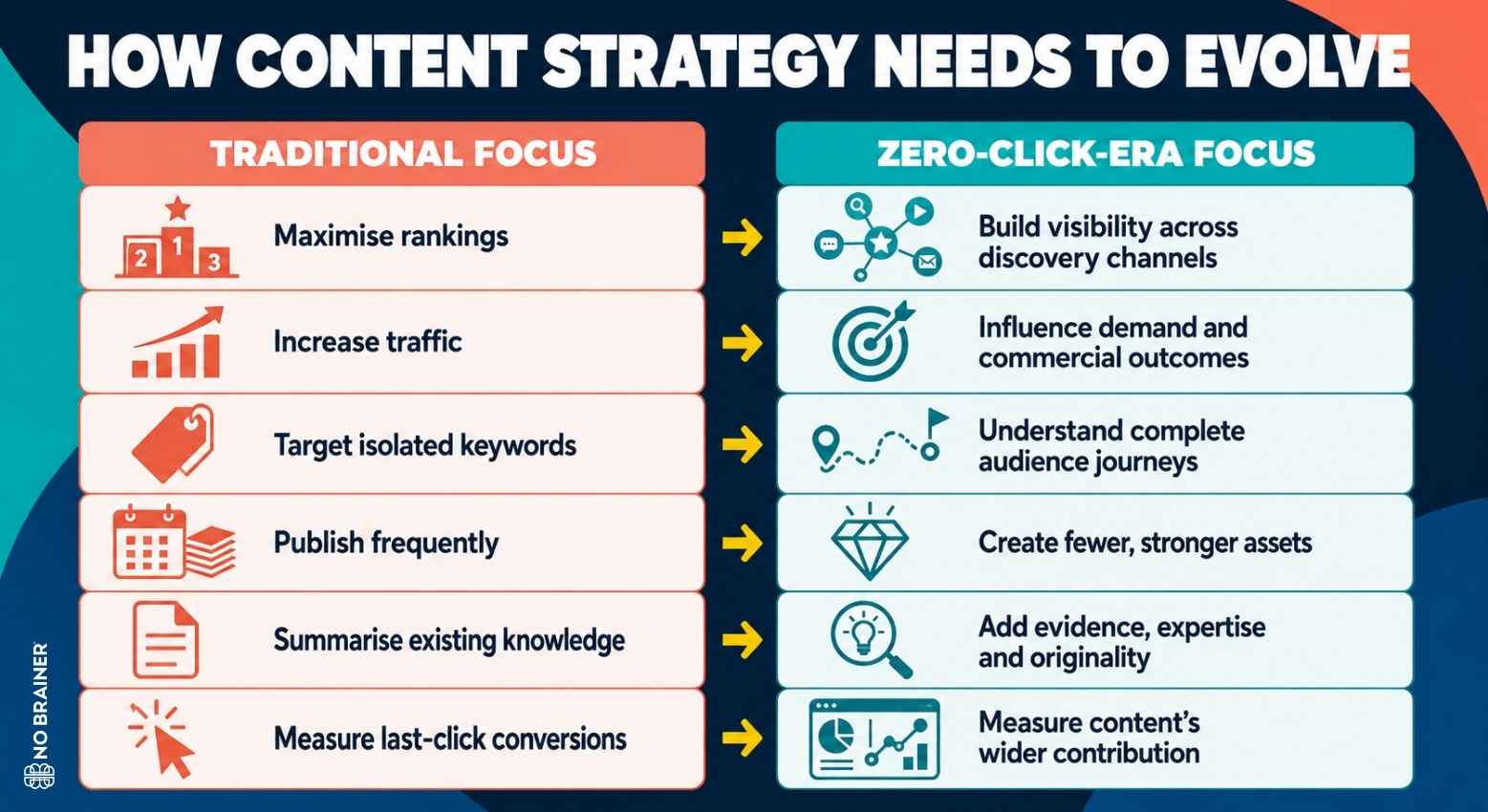
The zero-click era isn’t just changing the content we produce, it’s also changing how we plan it.
Start with audience understanding
Keywords remain important to ensure relevant users can find your content, but they shouldn’t dictate your entire strategy.
Begin by understanding the challenges, motivations and questions your audience has throughout their buying journey. What is the intent behind the search?
Create fewer, better assets
Rather than publishing multiple articles each week, invest in fewer pieces that provide exceptional value. A single high-quality industry report may deliver more commercial impact than dozens of generic blogs.
Build around expertise
Your business possesses knowledge that competitors don’t, and you have your own exclusive data as well as your people to draw on.
Capture insights from your specialists, customer conversations, anonymised data, project delivery and market experience to create content that’s impossible to replicate effectively.
Think beyond Google
Your audience discovers information in many places now. A successful content strategy considers search engines, AI assistants, social platforms, digital PR, email, communities and referral channels together rather than treating SEO in isolation.
Connect your content
Every piece you plan and publish should contribute to a wider content ecosystem.
Supporting guides, pillar pages, case studies, downloadable resources and related content help build topical authority while making it easier for users to continue their journey and make informed decisions.
Make your brand unforgettable
As AI answers become increasingly similar, brand becomes an even bigger differentiator. This is because people don’t just choose the best answer, they choose brands they recognise, trust and remember.
Measure success differently
Traffic remains an important indicator, but it shouldn’t be the only measure of success.
The exact metrics that matter for you will depend on your organisation’s objectives and wider targets, but some of the areas that businesses might also want to consider include:
- Brand search growth
- Qualified leads
- Pipeline contribution
- Returning visitors
- Time spent engaging with key content
- Assisted conversions
- Email subscribers
- Backlinks and media mentions
- Direct traffic
- Sales conversations influenced by content
Ultimately, content should support commercial growth and help turn site visitors into paying customers. If it doesn’t help users answer their questions, overcome their pain points and contribute meaningfully to the buying journey, it shouldn’t be a focus.