
Content audit fundamentals (with free template)

content audit template

Conducting a content audit on your website is one of the most useful, and potentially impactful, pieces of work you can do.

This is because, when done properly, a content audit gives you clarity. It shows you what’s actually working, what’s holding you back and where your biggest opportunities lie across SEO, AEO (Answer Engine Optimisation), and the wider customer journey.

For established sites in particular, content rarely fails because teams aren’t publishing enough. It fails because the content has grown over time, perhaps without a clear strategy throughout, without consistent ownership and without regular reassessment. Frequent Google algorithm updates and changes to user behaviour over time  can mean that content which once served a useful purpose might no longer be effective.

A content audit is how you regain control and ensure you’re maximising your existing content, as well as highlighting opportunities and ways to take your strategy forward. 

Jump to:

What is a content audit and why is it needed?

A content audit is a structured review of the content on your website, assessed against defined goals.

In practice, it’s far more valuable than a spreadsheet of data.

A good content audit helps you answer questions like:

  • Which pages actually contribute to organic performance and visibility?
  • Which low-value content is eating up crawl budget from search engines, weighing the website down?
  • Which content supports users at different stages of the buying journey?
  • Where is our content underperforming compared to competitors?
  • Which pages should we update, consolidate, or remove entirely?
  • How well is our content positioned for modern search behaviour, including AI Overviews, AI Search/LLMs and generative tools?

For many businesses and brands, website content has been created over time for a number of different reasons: campaign by campaign, product by product, keyword by keyword. This often leads to duplication, cannibalisation, outdated information and a site that feels fragmented to both users and search engines, which isn’t performing to anywhere near its potential.

A content audit gives you a strategic reset and a reliable foundation for future content and SEO decisions.

What types of site content should you include in an audit?

For a meaningful audit, it’s important not to limit yourself to blog posts alone. Depending on your goals and the kinds of content you have on the site, your audit might include:

  • Core service or product pages
  • Blog and editorial content
  • Guides, resources and evergreen assets
  • Landing pages (campaign or evergreen)
  • Category and hub pages
  • Support or help content
  • Thought leadership pieces
  • Video content

Define your content audit goals

Before you start to think about metrics, you need clarity on exactly why you’re auditing your content in the first place.

Without defined goals, audits become spreadsheets full of numbers but deliver very little meaningful insight.

Typical content audit goals include:

  • Improving organic visibility and SEO performance
  • Optimising content for AEO and AI-powered search results
  • Mapping content more clearly to the user journey
  • Increasing authority and trust with your audience
  • Better educating and informing potential customers
  • Addressing known user needs, questions and pain points
  • Supporting conversions and commercial outcomes

It’s particularly important to tie content performance back to business priorities, not vanity metrics. Traffic alone is rarely the ultimate goal; relevance, quality and intent matter far more.

Your audit goals will directly influence:

Determine the scope of the audit

With goals defined, the next step is setting realistic parameters about what to include in your audit.

Which pages are you auditing?

For smaller sites, a full-site audit may be manageable. For larger or older sites, you may need to prioritise:

  • Core commercial pages
  • High-traffic or historically important content
  • Pages targeting priority keywords or audiences

If SEO is a primary focus, it’s often sensible to exclude very new pages or content that’s been recently updated, as they won’t yet show meaningful performance trends and this can skew the data to some extent. You can always audit these pages further down the line once they’ve had time to bed in properly.

What timeframe are you measuring?

A 12-month+ view is usually a strong starting point. It allows you to:

  • Account for seasonality
  • Identify long-term trends rather than short spikes
  • Avoid overreacting to short-term fluctuations

Quantitative vs qualitative analysis

The most useful content audits blend data with human judgement. Numbers will tell you what is happening and qualitative review tells you why.

A page with strong impressions but low engagement, for example, may need better intent matching and a user journey review rather than targeting more keywords. Determining whether a page actually contains all of the info that a user needs at that stage of their journey in order to move forward is essential. Is the quality, style and tone of writing a good fit for your audience? Does it engage and connect with people?

How to measure content performance

This is where structure matters. Without it, audits can easily become very time-consuming and inconsistent.

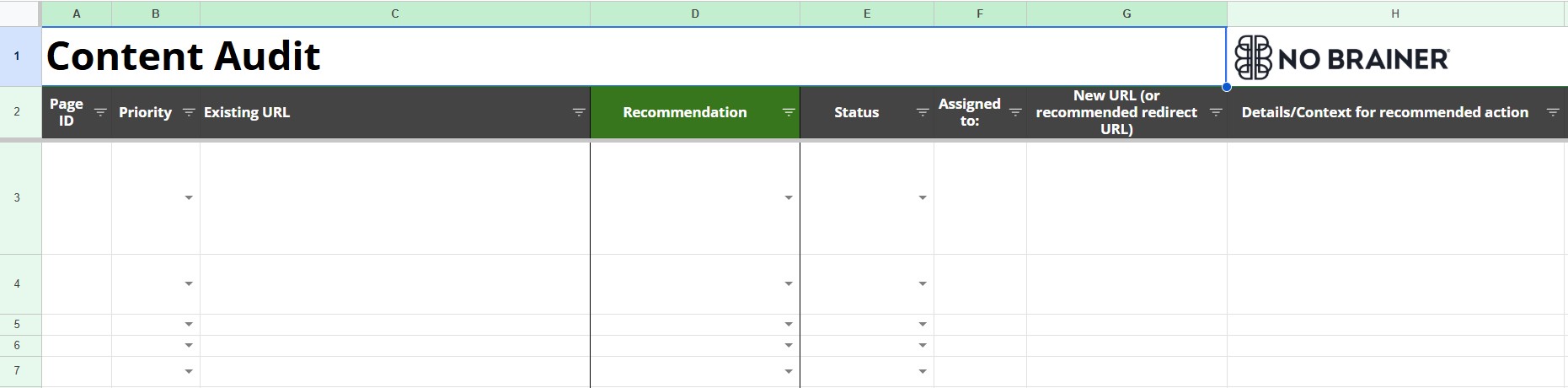
Start with a central content audit spreadsheet

Pull a full list of the URLs you’re auditing into a spreadsheet (ScreamingFrog is great tool to pull this together). This will become your single source of truth and helps your team to:

  • Standardise data inputs
  • Collaborate across SEO, content and wider marketing
  • Track actions and progress over time

Content audit template example

Core performance metrics to include

Although this will vary, depending your specific goals, useful data points typically include:

  • Organic sessions, impressions and clicks 
  • Primary ranking keywords, its search volume and average ranking positions 
  • Visibility in AI Overviews or generative tools like ChatGPT
  • Backlinks and referring domains
  • Historical performance trends and seasonality

On-page optimisation checks

For each page, assess whether core SEO fundamentals are in place:

  • Clear and optimised title tag
  • Compelling meta description
  • Logical H-tag structure
  • Sensible URL slug, aligned to page intent
  • Natural keyword inclusion
  • Internal linking to relevant content

These basics won’t compensate for weak content, but missing them can undermine strong content unnecessarily and put a ceiling on performance.

Audience and journey alignment

Every page should serve a clear audience and purpose.

Ask yourself:

  • Which persona or audience segment is this for?
  • Which stage of the buying journey does/should it support?
  • Is that role obvious to a first-time visitor?

Manual content quality review

This is where senior insight matters most.

For each page, consider:

  • Does the content genuinely fulfil its informational purpose?
  • Does it satisfy search intent?
  • Is it accurate and up to date?
  • Does it demonstrate experience, expertise, authority and trust (EEAT)?
  • Is the tone of voice consistent and on brand?
  • Is it easy to read and digest?
  • Does it follow the guidelines provided by Google for ‘helpful content’?
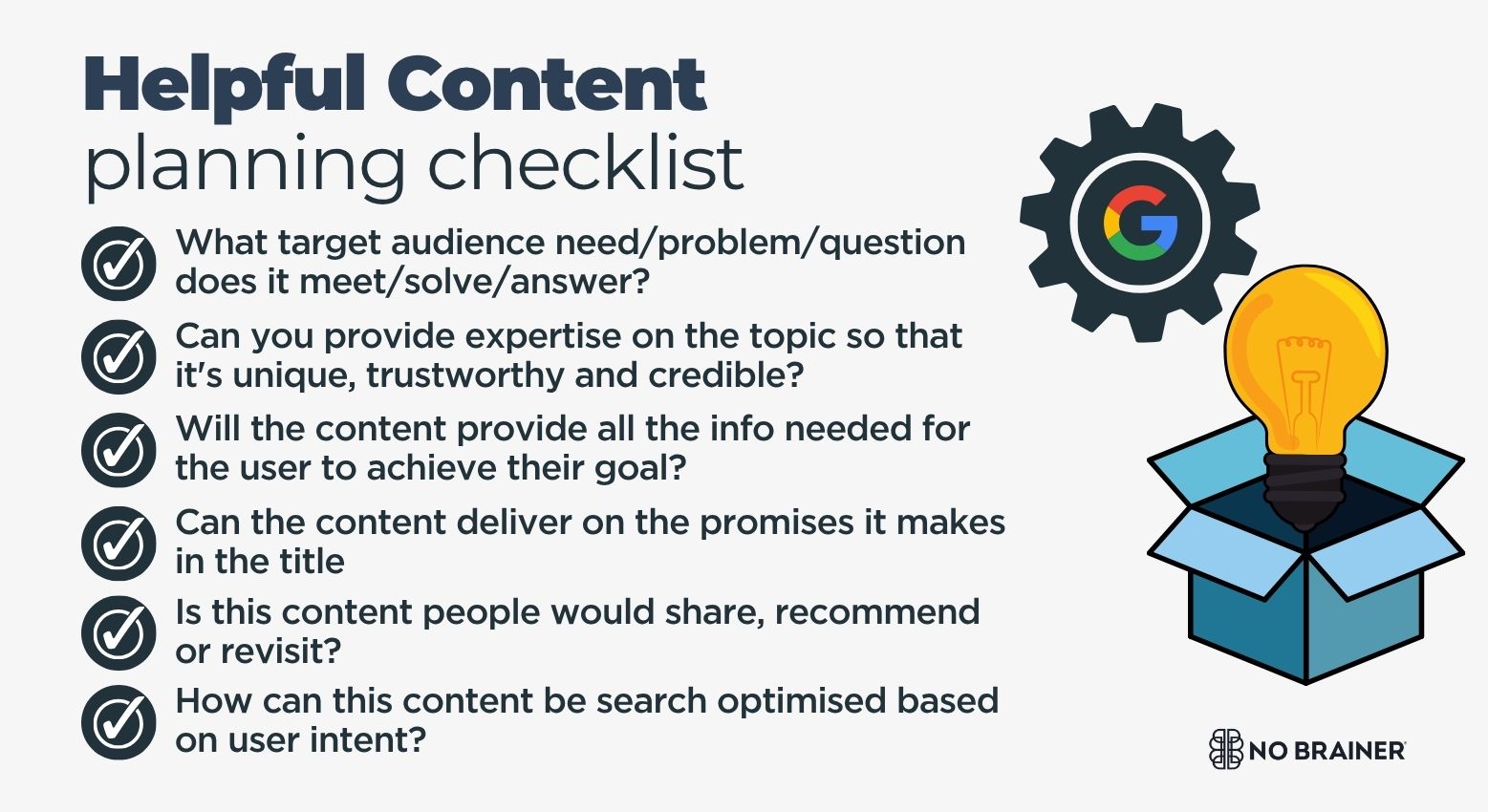
Helpful content checklist

Comparing your content to competitor pages that rank well for the same terms you’re targeting can be especially revealing too. Not to copy them, but to understand what users are responding to and what your page needs to be better than to stand out. 

Determine the action(s) needed

Once each page has been assessed, it’s time to decide what to do with it.

Leave unchanged: best all-round scores

If a page:

  • Performs strongly
  • Meets qualitative standards
  • Is accurate and up to date

…then the best action is often no action at all. Avoid the temptation to “improve” content that’s already doing its job but instead monitor it regularly.

That said, it’s worth flagging to review later so you can review the structure and layout, any media or creative assets used – all to understand if there’s any learnings you can bring forward. 

Update: content with potential

Updating is appropriate when content:

  • Underperforms relative to its importance and/or relevance
  • There’s demand for this content: Has opportunity to rank for a relevant keyword/phrase
  • Contains outdated information
  • Lacks depth, clarity or trust signals

Updates might include improving structure, refreshing examples, strengthening EEAT elements, or optimising for AEO by answering questions more directly.

Consolidate: merging similar and/or thin content

If multiple pages:

  • Target the same keywords
  • Serve the same audience need
  • Compete with each other

Consolidation can be powerful! You can combine overlapping or competing content into one stronger page, using the best-performing URL as the primary destination and redirecting the rest.

Remove or redirect: stopping low scored content from hurting your site

Deleting content is often a bit counterintuitive, especially if you know that a lot of time and effort went into creating that page or asset originally, but sometimes it’s more impactful to remove it entirely rather than leave it in limbo.

Pages that:

  • Receive no traffic
  • Have no backlinks
  • Serve no clear business or user purpose
  • Add no unique value

can actively harm site quality and use up crawl budget that could be more beneficial if focused elsewhere. Redirect these pages to the most relevant alternative to preserve any residual value.

Repurpose

You might also want to add another option – Repurpose. If there’s content that meets a few of your criteria but maybe isn’t in the right format for the target audience currently, or could potentially reach a whole new segment if it looks different or if used on different platforms or channels. 

While repurposing underperforming content won’t be your top priority in terms of post-audit actions, it can sometimes turn a piece of content from zero to hero if the opportunity and audience demand is already there in a different context.
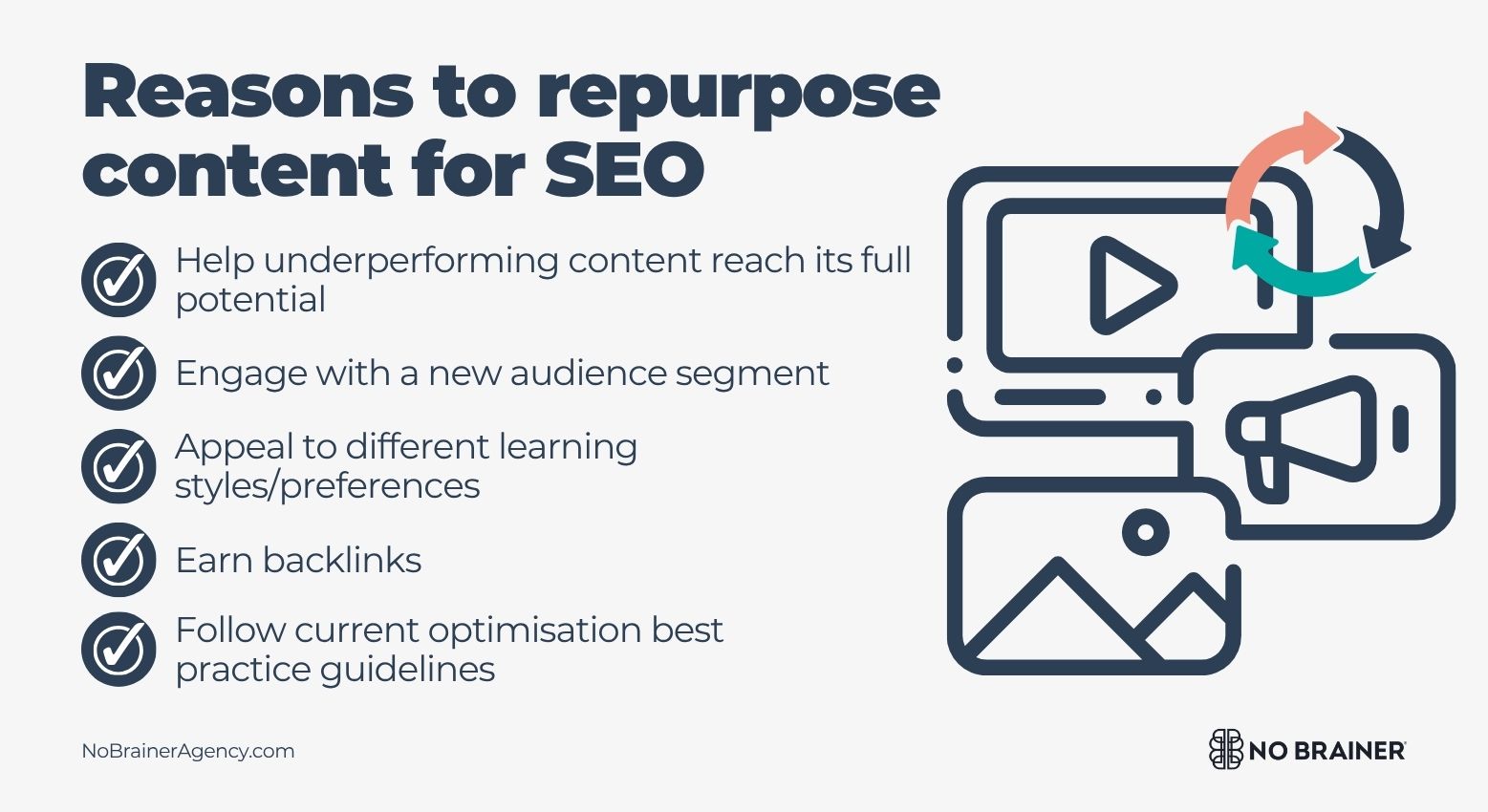
Reasons to repurpose content for SEO

Prioritise your actions

For larger sites especially, content audits aren’t a one-off task but instead help you form a roadmap.

Prioritisation should be driven by:

  • Business importance
  • Revenue impact
  • Strategic goals

Transactional and high-intent pages usually come first, followed by supporting and informational content.

If multiple people are involved in completing actions, use your spreadsheet to assign task ‘owners’, deadlines and statuses. This turns the audit from a static document into a living workflow that keeps everyone in the loop.

It’s essential to note the date that ALL audit actions have been completed so that you can accurately benchmark and measure future performance accurately. 

Ready to start auditing your content?

A content audit isn’t about achieving perfection. It’s about focus.

When carried out effectively, this kind of data gathering and analysis offers a much clearer view of what’s genuinely driving performance and what isn’t.

When paired with a strong content marketing and SEO strategy, a well-executed content audit can unlock growth without necessarily publishing a single new page. Your biggest content wins could already be hiding in plain sight, and a few tweaks could make all the difference. 

Grab your own copy of our free content audit template and get started!

Picture of Laura Rudd
Laura Rudd
I’ve worked in digital and content marketing for over 20 years, specialising in SEO since its inception. My career has spanned both agency-side and in-house roles, working alongside brands like HomeServe, Taking Care, Checkatrade, and AO.com. My expertise centres on SEO and content marketing, where I’m passionate about audience-first strategies that drive long-term organic performance.
Share this article
Want to chat?

Leave your details and one of our experts will contact you!